
Ambiguity is a Condition of Leadership
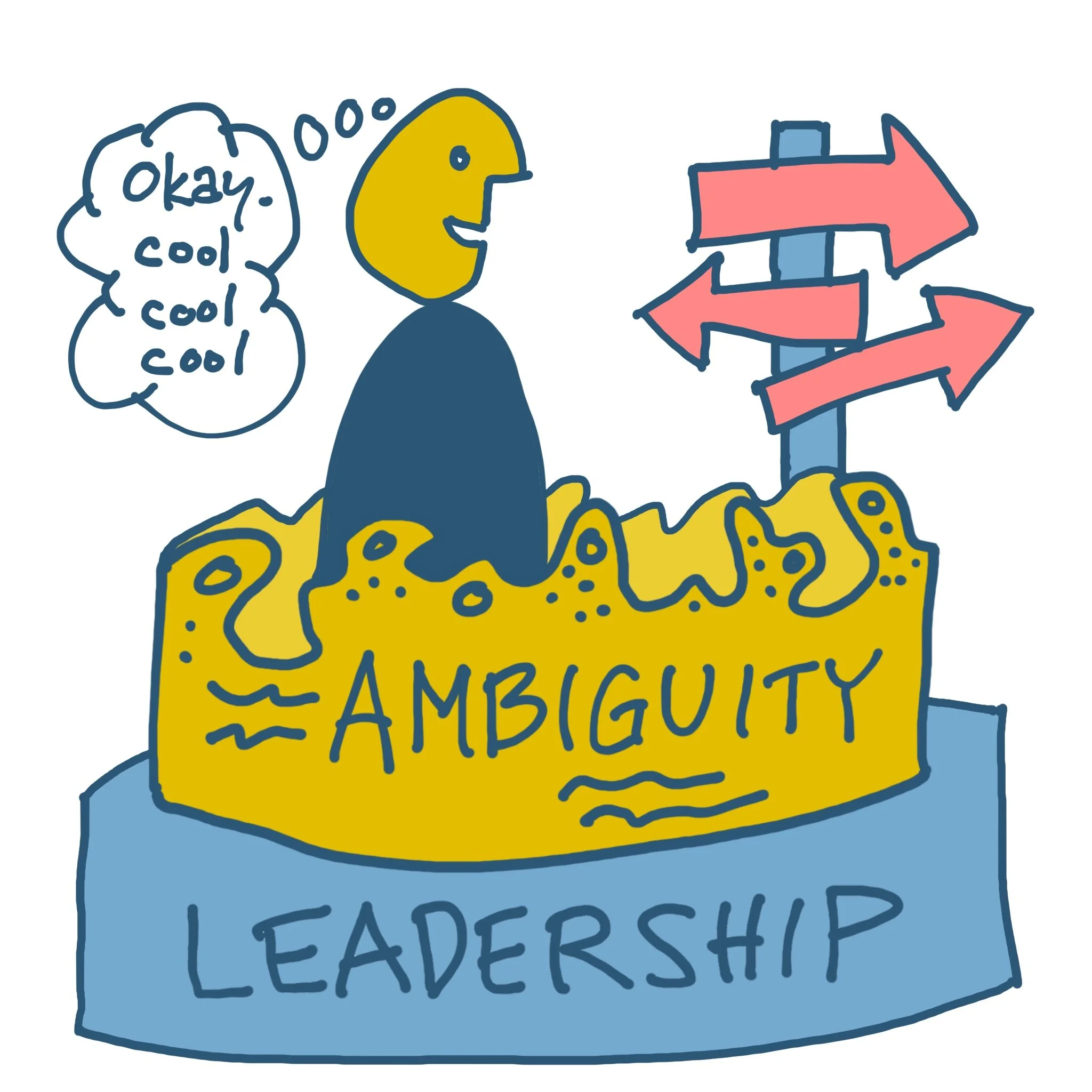
Ambiguity is the land of multiple possible meanings.
It’s where there isn’t one clear answer to the questions “What are we facing here?” or “What should we do next?”
There may be several reasonable interpretations, and none of them come with a guarantee.
That’s uncomfortable for a lot of people. And it turns out: that discomfort is not a leadership flaw. It’s a leadership requirement.
A coaching moment
In a recent coaching call, I helped someone connect ambiguity to leadership for the first time.
He had just been handed a new project at work. It was early in the planning stages. He had a million questions. Which made him feel anxious and also unsupported by his supervisor.
“What I really need,” he said, “is more information. More direction. More time to talk this through with my supervisor.”
I brought up his goal for our coaching meetings series.
“In our first meeting, you said that you’re feeling ready for more leadership opportunities. That you’re more confident now, six months into this role, and you’re wondering what your next steps might be.”
There was a long pause. The kind where you both stare at each other through the screen, and I wonder if I have made a big coaching misstep.
Then he laughed. “Oooooohhh. Careful what you wish for, right? Is that what you’re saying?”
“Well, that wasn’t the exact phrase in my mind. But yes.”
“So being brought in earlier on this project,” he said slowly, “this is my big chance?”
“Exactly. Think about how new work usually flows through any organization,” I said. “Senior leaders get it first. They think about it, and decide when and how to act, and then pass it to a team or individual to do the work.”
“They’re the ones who figure it out for everyone else.”
“Yes. Dealing with the unknowns, that’s leadership work.”
He frowned. “But that’s stressful.”
“Yes,” I laughed. “It really can be. And it gets easier with practice. Over time, it becomes normal to sit with uncertainty, organize what you do know, and bring others in to help shape the answer.”
“So this is the stress you get as a leader.”
“Yes. It’s the responsibility to make sense of ambiguity and take a stand, propose at least the first few steps of a strategy. With that stress comes power and opportunity. You get to be creative. You get to design collaboration instead of waiting for instructions. You get to influence how the work unfolds.”
(Or something like that! This dialogue is not 100% accurate, but this is how the conversation proceeded.)
The disconnect
For people who are deeply allergic to uncertainty and eager to be offered leadership opportunities, that’s a big disconnect.
When everything is clearly defined, step-by-step, with detailed instructions, there’s very little ambiguity. There’s also very little room to demonstrate judgment, strategy, or leadership.
When we ask for leadership growth, whether that’s a promotion, being asked to lead a project, or being trusted with more responsibility, we are asking for more ambiguity.
That’s what decision-making power actually is: figuring out the best way forward among multiple possible paths, knowns, and unknowns.
Complexity vs. ambiguity (they’re not the same)
This is where it helps to separate two concepts that often get tangled together: complexity and ambiguity.
Complexity is about conditions. Many moving parts. Interdependent systems. Layers of people, processes, technologies, timelines.
Ambiguity is about interpretation. It’s how we make sense of those conditions. An ambiguous situation can be understood in more than one way. It requires exploration, judgment, and learning before action is clear.
You can sometimes solve complex problems by breaking them down.
Ambiguous problems require something different: Interpretation. Choice. Risk.
And risk is the key word here.
When someone tells us exactly what to do, we are safe from risk. We are also safe from the opportunity to demonstrate our ability to analyze, interpret, and decide—in other words, to lead.
Stress isn’t the enemy
I often think about the classic TED Talk by Kelly McGonigal on stress (which we discuss in my leadership course). One of her core points is that how we think about stress shapes how our bodies and minds respond to it.
If we believe stress is always bad, something to eliminate at all costs, we resist it. We tense up. We shut down.
But if we understand stress as a signal that we’re engaged in something meaningful, something that matters, our relationship to it changes.
Ambiguity creates stress because it asks something of us. It asks us to think, to choose, to take responsibility.
That doesn’t mean leaders don’t feel stress. It means they don’t interpret stress as a sign that something has gone wrong.
“That’s above my pay grade”
When someone says, “I’ll have to ask my manager,” or “That’s above my pay grade,” they’ve correctly identified ambiguity and complexity.
Sometimes that’s appropriate. And sometimes it’s a habit worth examining.
For new and emerging leaders, the real growth edge is learning to stay present in ambiguity rather than immediately handing it upward. To resist the urge to wait for the boss to tell them exactly what to do.
What I hear from many Gen X leaders and older Millennials is this: they see capable team members who want leadership opportunities—and who struggle and shy away when the work isn’t clearly defined.
That struggle isn’t a personal failing. It’s a skill gap. And it’s one that can be practiced.
The bottom line
Ambiguity is not something leaders graduate out of. It’s something they graduate into.
If you want to grow as a leader, the question isn’t “How do I eliminate ambiguity?” It’s “How do I get more comfortable working inside it?”
Because ambiguity is where interpretation happens. And interpretation is where leadership lives.